Jean-Paul Clébert’s house

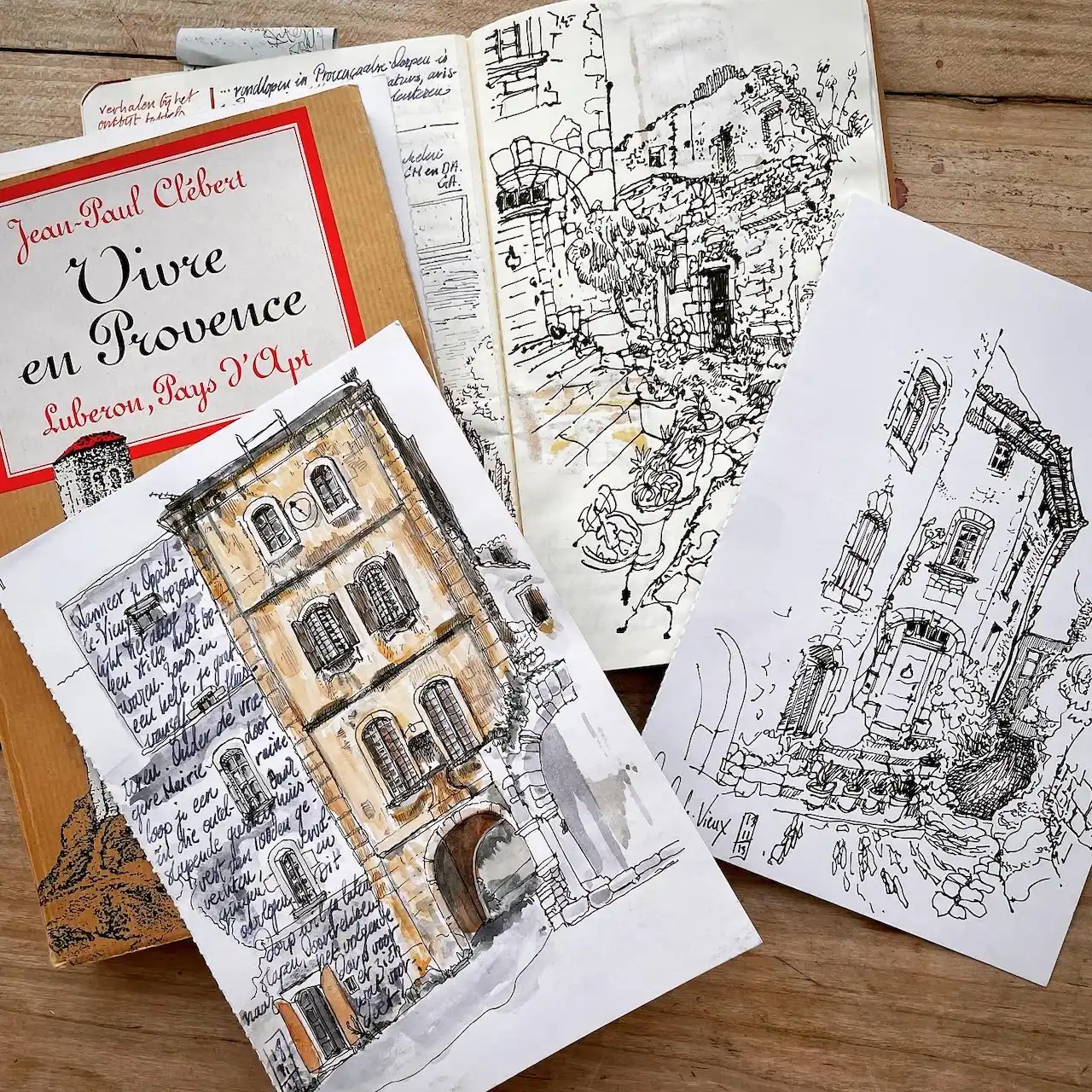
Three sketches of Oppède-le-Vieux and book

Reading ‘Vivre en Provence’ by Jean-Paul Clébert (1926-2011), the Jack Kerouac of French literature. I may assume that, according to his description, I’ve drawn his house in Oppède-le-Vieux several times. In another rather bizarre coincidence, I wrote a text on the façade as if to say: this was the house of a writer. Instinct?

Additionally, Clébert’s exploration of the natural environment is profound. For instance, he illustrates the impact of the changing seasons on the landscape, describing how the olive trees transform with the passage of time, their gnarled branches bearing witness to the passage of generations. His reflections on the cyclical nature of life in Provence resonate deeply, connecting the reader not just to the physical beauty of the region, but to its cultural and historical significance.

Moreover, Clébert’s narratives are peppered with anecdotes that, while lacking the humor of Mayle, bring authenticity to his portrayal. For example, he recounts a story of a local farmer who, despite facing adversity, continues to cultivate his land with passion and dedication. This farmer’s unwavering commitment to his craft serves as a testament to the strong connection between the people and the land, a central theme in Clébert’s work.

Clébert’s influence on the Situationist movement is particularly significant. His notions of ‘dérive’ emphasize the importance of experiencing a place in an unstructured, spontaneous way. This concept invites individuals to wander freely through their environment, allowing for personal discovery and a deeper connection to the surroundings. In my project, I drew inspiration from this philosophy, encouraging others to engage with the landscape in a meaningful manner. By traversing the stone quarry and olive oil mill, one can truly appreciate the beauty and complexity of the region, as Clébert intended.

olive tree in the Luberon landscape

Each sketch tells a story, echoing the themes of resilience and beauty that Clébert articulates. For example, one of my drawings depicts the olive trees at sunset, their silhouettes stark against the vibrant hues of dusk. This image encapsulates the essence of Clébert’s work, where the ordinary becomes extraordinary through an attentive gaze and a receptive heart.

The sketches I created during my travels are not just artistic representations; they are a tribute to Clébert’s vision. Each stroke of the pencil captures not only the physical attributes of the landscape but also the emotional resonance Clébert evokes in his writing. As I reflect on my experiences, it becomes clear that Clébert’s influence extends beyond literature into the realm of art and personal expression.

While authors like Peter Mayle bring a lighthearted perspective to the region, Clébert offers a more nuanced and sometimes stark reflection on life in Provence. His writing delves into the realities faced by the locals—their struggles, traditions, and the indomitable spirit that defines them. For example, he doesn’t shy away from discussing the economic hardships that the community faces, especially in the agricultural sector. This honesty provides a counterbalance to the romanticized versions of Provence often portrayed in mainstream literature.

In this captivating narrative, Clébert paints a vivid picture of life in Provence that transcends mere aesthetics. His prose is rich with detail, inviting readers to immerse themselves in the landscape, the culture, and the people. Consider, for instance, his descriptions of the rustic charm of the villages, where time seems to stand still. The winding streets of Oppède-le-Vieux, with their ancient stones and sun-drenched facades, come alive through his words, almost as if one can feel the warmth of the sun and hear the whispers of history echoing in the alleyways. This ability to evoke such imagery is what sets Clébert apart from his contemporaries.

Most people will think of Peter Mayle when referring to life in Provence. I would rather recommend Clébert. Not as romantic as Pagnol, no tung-in-cheek anecdotes as Mayle, but the real stuff in a beautiful but sometimes harsh environment. Unfortunately less known and hard to find in translation, but for me, Clébert is right up there with Giono and Bosco.

In my project involving the stone quarry of Oppède and the olive oil mill Saint Augustin, the principles of Clébert are a guide. I so discovered that the Situationist movement (Guy Debord) based their theory of the ‘dérive’ on his writing. (More on that later.)

In the picture: my sketches from 2012-2013 with a 1977 edition of the book.


Glasses signature


Leave a Reply

Your email address will not be published. Required fields are marked *

This site uses Akismet to reduce spam. Learn how your comment data is processed.